

Common Misconceptions About
Perforated Plate for Aggregate Screening
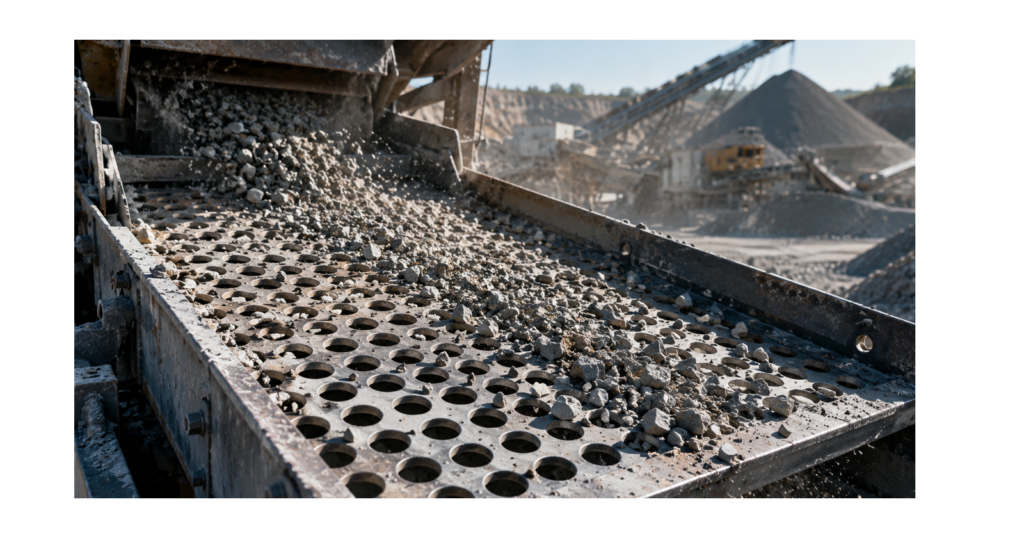
Many people still think of a perforated plate as a simple steel sheet with round holes punched through it with only a few standard configurations available.
While that may have been true decades ago, modern perforated plate offers far more flexibility than many operators realize. Today, it can be engineered around the specific demands of an application, including material type, impact level, desired open area, equipment configuration, and wear conditions.
Custom perforated plate can be designed to improve wear life, reduce pegging, protect high-impact areas, and deliver the strength and screening performance required for a particular operation.
Here are six common misconceptions about perforated plate—and what aggregate producers should know before choosing screening media.
Myth #1: Perforated Plate Is Always Thin
Reality: Perforated plate can be built for demanding aggregate applications.
Commercial perforated sheets are often relatively thin, which may explain why some people assume all perforated plates are lightweight.
Aggregate screening applications, however, can require something much more substantial.
A heavy-duty perforated plate is commonly used in high-impact areas, including the top deck of a screen box, where it can absorb the initial force of incoming material and help protect more delicate screening media below.
Depending on the application, a perforated plate can be customized for added strength, longer wear life, and improved resistance to abrasive material.
Customization options may include:
- Plate thickness
- Aperture size and shape
- Opening pattern and spacing
- Blank-out areas
- Skid bars
- Overall dimensions
- Mounting and support requirements
Rather than choosing from a limited catalog of standard panels, operators can specify a plate designed around their equipment and operating conditions.
For high-impact or abrasive applications, heavier steel may provide the structural strength and wear resistance needed to keep the screen performing longer.
Myth #2: You Only Get a Few Hole Sizes
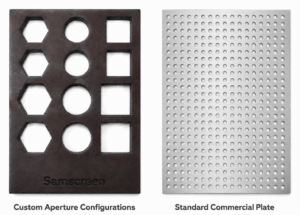
Reality: Modern manufacturing allows for a wide range of aperture sizes, shapes, and patterns.
Mass-produced perforated plate is often offered in a relatively limited selection of standard openings. Custom manufacturing makes it possible to produce a much wider range of aperture configurations.
Available options may include:
- Round openings
- Hexagonal openings
- Octagonal openings
- Custom opening patterns
- Apertures larger than one inch
The right aperture depends on the material being processed, the desired product size, and the performance goals of the operation.
One important advantage of custom perforated plate is that aperture size and plate thickness do not always have to be treated as a package. Closely spaced openings can be incorporated into heavier plate, allowing operators to balance open area, structural strength, and wear life.
The result is a plate designed around the application rather than a standard hole pattern that may or may not provide the desired performance.
Myth #3: All Perforated Plate Performs the Same
Reality: Aperture geometry can affect open area, material flow, strength, and pegging resistance.
At first glance, many perforated plates may look similar. Their performance, however, can vary considerably depending on the shape, spacing, and profile of the openings.
Round, hexagonal, and octagonal apertures each create a different balance between open area and the amount of steel remaining in the plate.
Hexagonal openings, for example, can provide a high percentage of open area while preserving the structural strength of the plate. Depending on the application, that combination may help support:
- Increased screening capacity
- Improved material flow
- Reduced pegging
- Reduced blinding
- Greater effective open area
- The profile of the aperture can also matter.
Samscreen can manufacture openings that are slightly wider at the bottom than at the screening surface. This tapered design helps near-size material pass through the plate rather than becoming lodged in the opening.
By helping material release more freely, the aperture design may improve screening efficiency and maintain more usable open area during operation.
Myth #4: Perforated Plate Cannot Be Customized
Reality: Perforated plate can be engineered around both the screen box and the wear patterns of the application.
The prevalence of mass-produced panels can make perforated plate appear like a standardized product. Custom plate, however, can be modified in several ways to address specific production and maintenance concerns.
In addition to aperture size, shape, spacing, and plate thickness, customization options may include:
- Blank-out areas in high-impact zones
- Skid bars over support locations
- Reinforced sections
- Custom dimensions
- Special mounting requirements
- Opening layouts matched to the support structure below
Blank-out areas can protect portions of the plate that receive the greatest impact. Skid bars can help shield crossbars and reduce direct wear over the support structure.
Perforated plate can also be repaired or modified in the field in some applications. In some applications, perforated plate may also be repairable or modifiable in the field, depending on the plate design, equipment, and operating conditions.
The objective is not simply to manufacture a panel that fits. It is to build one that accounts for where material lands, where the plate is supported, and where wear is most likely to occur.
Explore standard and custom perforated plate hole shapes on our Perforated Plate product page.
Myth #5: Perforated Plate Is Only for the Top Deck
Reality: Perforated plate can be used in several locations, although it is not the best choice for every deck or application.
Perforated plate is frequently associated with top-deck applications because it performs well under heavy impact and with larger feed material.
It may also be used in other high-wear, scalping, or sizing applications where strength, durability, and controlled openings are important.
Applications that may benefit from perforated plate include:
- Heavy-impact screening
- Scalping
- Large feed material
- Abrasive stone
- High-wear deck positions
- Applications requiring rigid, consistent apertures
That does not mean perforated plate is the right solution for every screening position.
Self-cleaning media may be a better fit when blinding and pegging are persistent problems, particularly when material is damp or difficult to screen.
Many operations use more than one type of screening media within the same screen box. A heavy-duty plate may protect the top deck, self-cleaning media performs the finer separation work below.
The goal is not to use perforated plate everywhere. It is to use it where its rigidity, strength, and wear resistance provide the greatest value.
Myth #6: Perforated Plate Doesn’t Require Maintenance
Reality: Every screening surface eventually wears, but proper design can significantly improve service life.
Perforated plate is known for durability, but no screening media lasts forever.
Over time, impact, abrasion, material flow, and vibration will wear the plate and its openings. Apertures may become enlarged, the plate may thin in high-wear areas, or cracks may develop near supports and mounting points.
The useful life of a plate depends on factors such as:
- Material abrasiveness
- Feed size
- Impact level
- Tonnage
- Plate thickness
- Aperture design
- Support placement
- Installation
- Maintenance practices
A properly designed plate can distribute wear more effectively, reinforce vulnerable areas, and protect the support structure below.
This is why the lowest initial price does not always represent the lowest operating cost. A custom plate that lasts longer, requires fewer repairs, and reduces unplanned changeouts may deliver a lower cost per ton processed.
| Production Problem | Potential Design Solution |
|---|---|
| Heavy material impact | Blank-out areas or reinforced impact zones |
| Crossbar wear | Skid bars or protected support areas |
| Frequent pegging | Alternative aperture geometry or tapered openings |
| Abrasive material | Heavier or wear-resistant plate |
| Limited open area | Optimized aperture size, shape, and spacing |
| Unusual screen box | Custom dimensions and mounting details |
| Obsolete equipment | Built-to-spec replacement plate |
| Uneven wear patterns | Customized opening and reinforcement layout |
These design choices allow the plate to be built around the way material actually moves through the operation.
Instead of asking, “Which standard plate is closest to what we need?” operators can begin with a better question:
“What plate design will best address the production problem we are trying to solve?”
When Should You Choose Perforated Plate?
Perforated plate may be a strong choice when an application involves:
- Heavy impact
- Large feed material
- Abrasive stone
- Scalping
- High-wear areas
- A need for rigid, consistent openings
- Protection of screening media on lower decks
- Custom equipment or unusual deck dimensions
Another type of screening media may perform better when maximum open area, flexibility, or self-cleaning action is the primary concern.
Choosing the right option requires looking at the complete application, including the material, feed size, moisture level, desired separation, deck position, support structure, and production targets.
Perforated Plate Is More Than Punched Steel
Perforated plate has evolved far beyond a simple sheet of steel with a few standard holes.
Modern custom perforated plate can be engineered to improve wear life, increase usable open area, protect critical wear zones, reduce maintenance, and match the exact dimensions of the equipment.
The right design begins with the application—not with a standard catalog.
Need a Custom Perforated Plate?
Our team can help design perforated plate around your equipment, material, wear conditions, and production goals.
Contact Samscreen to discuss the specifications for your application.